
Mission Statement
Our goal is to understand the processes that drive biodiversity patterns and their spatio-temporal dynamics across scales, the assembly of ecological communities, the factors that determine the value of landscapes for ecosystem service provision
By observing and predicting the long-term effects of global change and of socio-economic activities (including climate and landuse change, landscape fragmentation and habitat loss, biological invasions) on biodiversity patterns, we want to provide the knowledge basis for sound conservation management and ecological restoration.
News & Publications

2026-09-15
Open PhD Position
We are seeking a highly motivated Predoctoral Researcher / PhD Candidate in quantitative agroecology, data integration and biodiversity modelling for the FWF-funded project EU-OLIVES(“Biodiversity and Ecosystem Services in EU Olive Farming”) at the University of Vienna, for a 36-month position from 1 February 2027 to 31 January 2030 (30 hours/week).

Hausharter, J., Wessely, J., Helm, N., Chytrý, K., Hülber, K., Moser, D., García Lino, M.C., Kagerl, K., Lamprecht, A., Lenoir, J., Kollert, A., Mayr, A., Rutzinger, M., Choler, P., De Frenne, P., Lembrechts, J.J., Abdaladze, O., Andrews, C., Barančok, P., Benito-Alonso, J.-L., Cañadas, E.M., Carbognani, M., Carnicero, P., Corcket, E., Di Musciano, M., Dick, J., Gigauri, K., Hilpold, A., Jiménez, J.J., Lorite, J., Morra Di Cella, U., Nyktas, P., Orsenigo, S., Palaj, A., Petey, M., Pușcaș, M., Randin, C., Remoundou, I., Rixen, C., Saccone, P., Stanisci, A., Theurillat, J.-P., Ursu, T.-M., Vanneste, T., Von Büren, R.S., Wipf, S., Winkler, M., Pauli, H. & Dullinger, S.
Widespread thermophilization but weak link to climate warming in Europe’s summit plant communities
In this study we investigated whether warming temperatures drive the increasing dominance of warmth-associated species in alpine plant communities across Europe. Although thermophilization and warming occurred concurrently and were related at broad regional scales, local vegetation changes were more strongly influenced by abiotic site conditions and the availability of potential colonizing species than by temperature trends alone.
Nature Ecology & Evolution, Volume 10, Issue 10, October 2026
doi.org/10.1038/s41559-026-03150-x
Johannes Wessely, Kryštof Chytrý, Andreas Gattringer, Johannes Hausharter, Norbert Helm, Karl Hülber, Dietmar Moser, Otar Abdaladze, Christopher Andrews, Elena Barni, Debora Barolin, José-Luis Benito-Alonso, Raphael S. von Büren, Michele Carbognani, Pau Carnicero, Valter Di Cecco, Philippe Choler, Jan Dick, Rosa Fernández-Calzado, Pieter De Frenne, Mary Carolina García Lino, Dany Ghosn, Khatuna Gigauri, Bente J. Graae, Andreas Hilpold, Juan J. Jiménez, Katharina Kagerl, Róbert Kanka, Jozef Kollár, Andrea Lamprecht, Jonas Lembrechts, Jonathan Lenoir, Juan Lorite, Panagiotis Nyktas, Mihai Pușcaș, Christophe F. Randin, Christian Rixen, Graziano Rossi, Patrick Saccone, Tudor Mihai Ursu, Thomas Vanneste, Marco Varricchione, Pascal Vittoz, Manuela Winkler, Sonja Wipf, Harald Pauli, Stefan Dullinger
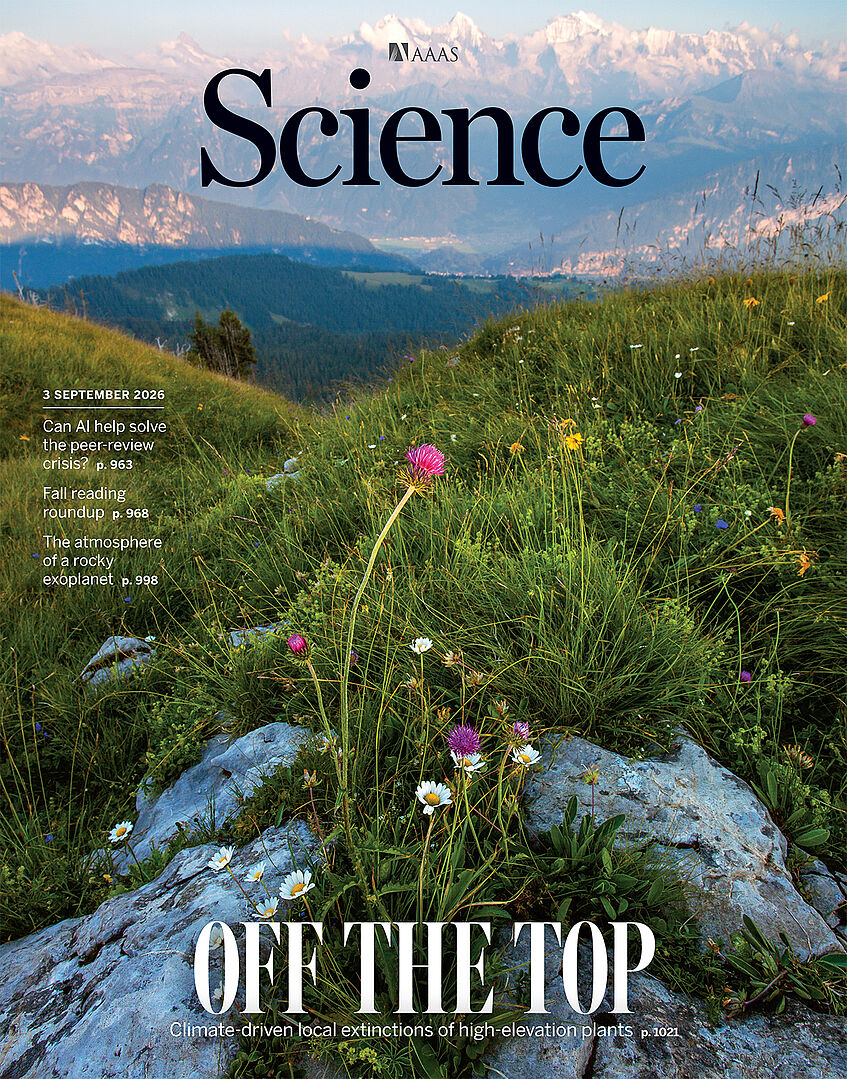
Rising plant extinction rates on European mountain summits
Climate change increases plant species richness in alpine ecosystems. However, to what extent this diversity enrichment masks extinction dynamics of resident species remains elusive. In this study, we used floristic resurvey data from 896 permanent vegetation plots across 62 European mountain summits to show that local extinctions have increased over the past 21 years. Extinction rates rose with the magnitude of warming, and species were more likely to go extinct toward their low-elevation range margins and in communities undergoing stronger thermophilization. Moreover, local extinctions were significantly related to preceding abundance declines, which can serve as an early warning signal. These findings suggest that despite increasing plant species richness, plant assemblages above the treeline face an accelerating but so far neglected loss of their most characteristic species.
Science Volume 393, Issue 6815, 3. September 2026
DOI: 10.1126/science.aed2974
Giliba RA, Loos J, Fiedler K (2026)
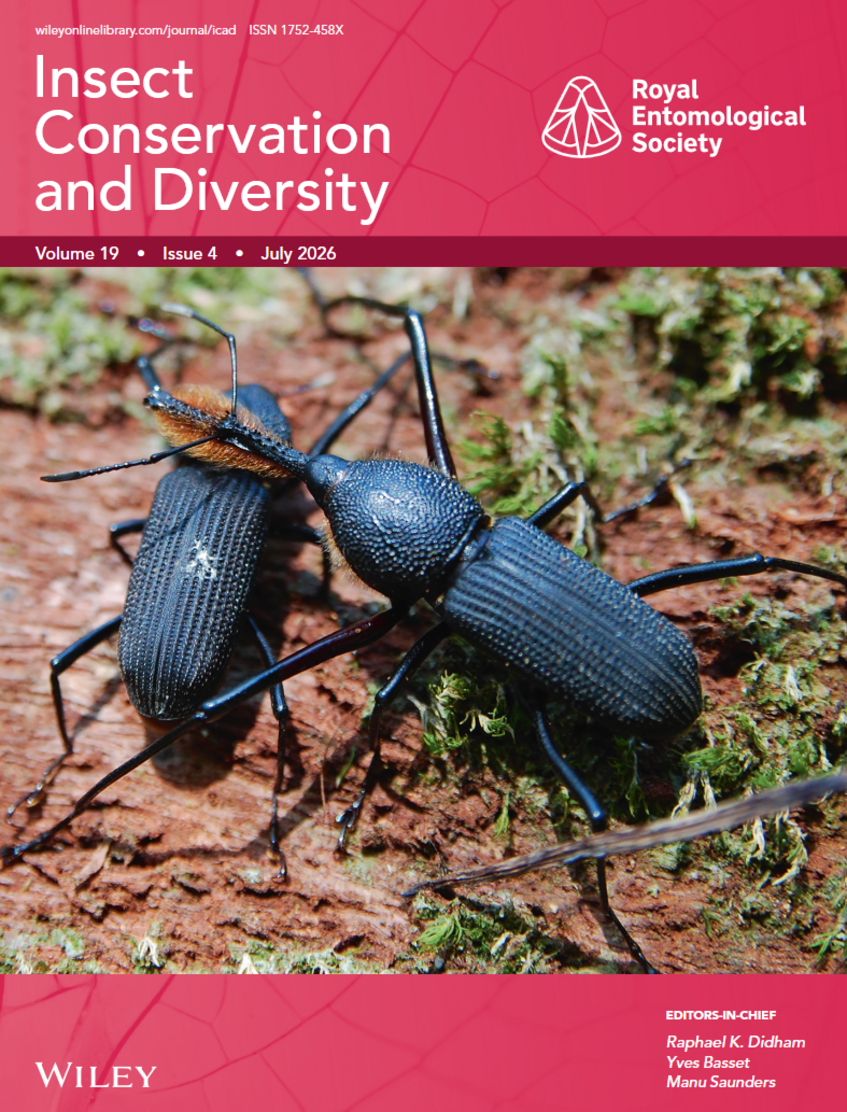
Protection status and environmental gradients shape butterfly assemblages in an East African tropical ecosystem
Insect Conservation and Diversity doi.org/10.1111/icad.70125

Kropik, M., Zechmeister, H.G. 2026
Shifting urban baselines limit the abundance-based resolution of a classical lichen indicator
Ecological Indicators, Volume 189, August 2026, 115071https://doi.org/10.1016/j.ecolind.2026.115071
Kachali RN, Loos J (2026)
Navigating equity in protected and conserved areas: a literature map of conceptualizations and practical applications.
Local Environment. doi.org/10.1080/13549839.2026.2615020.

2026-05-04
Moosflora von Österreich
Anlässlich der Veröffentlichung der Moosflora von Österreich hat „Der Standard“ ein Interview mit unserem Kollegen Harald Zechmeister geführt, in dem Einblicke in das Werk sowie in die Vielfalt und Bedeutung der Moose gegeben werden. Der Artikel ist hier nachzulesen:
www.derstandard.at/story/3000000312826/die-geheimen-tricks-der-1105-moosarten-in-oesterreich

Berg, C., Köckinger, H., Kropik, M., Pöltl, M., Schröck, C. & Zechmeister, H. G. [Hrsg.] 2025.
Moosflora von Österreich. Band 1 bis 3.
Verlag des Naturwissenschaftlichen Vereins für Kärnten, Klagenfurt am Wörthersee, 1182 + LXXXVI S. im Anhang.
Mailing List
Subscribe to our mailing list for events, announcement, job offers and general information.